Geography, Corridors, and the Search for Strategic Added Value
This essay answers the following questions: Is neo-Ottomanism driven by imperial ambition, or by fear of marginalization within emerging geoeconomic corridors? What are the strategic implications?
Abstract
This essay argues that contemporary Turkish neo-Ottomanism is not primarily an ideological revival, but a geostrategic response to structural vulnerability. Lacking the demographic, economic, and technological depth of a great power, Turkey seeks to convert geography into strategic added value by positioning itself as an indispensable corridor between Eurasia and Europe. The ambition to control or influence transcontinental trade and energy routes—particularly through the Middle Corridor and the Iraq Development Road—constitutes the material foundation of its external activism.
However, these land-based architectures face instability and systemic constraints. The emergence of the India–Middle East–Europe Corridor (IMEC), rooted in maritime Rimland logic, poses a structural challenge by potentially bypassing Turkish territory. The essay contends that Turkish behavior across the Levant, the Eastern Mediterranean, the Red Sea, and the Horn of Africa should be understood as a rational strategy of controlled friction: not a pursuit of war, but an attempt to raise the cost of alternative corridors.
Interpreted through a Thucydidean framework—Fear, Interest, and Honour—neo-Ottomanism emerges as an effort to prevent geopolitical marginalization in a world increasingly structured around corridors of wealth and strategic compression.
Turkish neo-Ottomanism
Turkish neo-Ottomanism is often interpreted as ideological nostalgia or as the personal project of a particular political leadership. Both interpretations contain elements of truth. Yet neither reaches the structural core of the phenomenon. What is commonly described as ideological revival is better understood as a geostrategic response to material constraints. The driving question is not historical memory but geopolitical function: how can Turkey transform its geography into indispensable value within an international system increasingly organized around corridors of wealth?
The Structural Insecurity of Turkey
Turkey does not possess the demographic scale, financial depth, or technological base of a great power. It is neither an energy giant nor a global financial hub. Its economy depends heavily on external investment and export competitiveness, often sustained through currency depreciation at the cost of inflation and social erosion. Arms exports, while impressive, cannot alone sustain durable power without continuous technological renewal and capital accumulation. Structural vulnerability thus coexists with regional ambition.
Beneath these economic limitations lies a deeper psychological and strategic layer: the persistent fear of fragmentation. The late Ottoman collapse, the violent ruptures of the early twentieth century, the enduring Kurdish question, and the erosion of minority presences have embedded a security reflex within the Turkish state. Identity issues are routinely securitized. Internal cohesion and external activism are tightly interwoven. Projection of power functions not merely as foreign policy but as an instrument of internal consolidation.
Within this framework, geography emerges as the principal comparative asset of Turkey. Straddling Europe and Asia, linking the Black Sea to the Mediterranean, and bordering the Caucasus and the Levant, Turkey occupies a pivotal position. Yet geography produces power only when it becomes indispensable. A bridge that can be bypassed has limited leverage. A passage whose disruption increases systemic cost becomes strategic capital. The enduring relevance of the regime of the Dardanelle Straits offers a template: control over chokepoints can transform geography into influence. Contemporary Turkish strategy seeks to generalize this logic across its broader territorial space.
From Geography to Corridor Strategy
To convert positional advantage into monetizable and coercive leverage, Ankara promotes corridor-based architectures that place Turkey at the center of transcontinental flows.
Two projects stand out:
The first is the western extension of Chinese Belt and Road Initiative through the so-called Middle Corridor, connecting Central Asia to Europe via the Caspian Sea, the South Caucasus, and eastern Anatolia [Baku (Azerbaitzan)–Zangezur (Armenia)–Kars (Turkey), see map 1]. This route aspires to bypass Russia and reduce reliance on Iranian territory while positioning Turkey as a key intermediary between East Asia and Europe.
The second is the Development Road of Iraq, originating at the Grand al-Faw port on the Persian Gulf and extending northward through Iraqi territory toward the Turkish border (Ovaköy), with onward integration into European markets (see map 2). If consolidated and expanded toward the Caucasus, this axis would establish a Turkey-centric land bridge linking the Eurasian heartland to Europe.
The ambition is clear: to become the unavoidable intermediary between continental Asia and Europe.
The Structural Constraint
The difficulty lies in geography itself. The regions through which these land corridors must pass—the South Caucasus, northern Iraq, Syria—are zones of chronic instability. Ethnic conflict, sectarian tension, fragile state structures, and great-power rivalry create an uncertain security environment. Large-scale corridor projects require predictability; instability multiplies risk, encouraging the seek for alternatives.
To render such corridors viable, Turkey must shape, influence, or partially control the security environment along their routes. Its military presence in northern Syria, its consolidation of control in northern Cyprus, its intervention in Libya, and its base in Somalia should not be read as disconnected episodes. They form part of a broader attempt to construct strategic depth along an extended arc of influence.
In this light, neo-Ottomanism is less an imperial fantasy than a legitimizing narrative. It provides ideological coherence and domestic mobilization for what is fundamentally a geo-economic project: the conversion of geography into structural leverage. Historical continuity becomes a mobilizing language for corridor politics.
Competing Architectures: Land versus Maritime Logic
The land-based corridor strategy of Turkey does not unfold in a vacuum. It faces structural limitations not only from regional instability but from systemic geopolitics. The Middle Corridor primarily facilitates the connectivity of China to Europe, and is therefore entangled in the broader strategic rivalry between Washington and Beijing. It cannot be treated as a neutral infrastructure initiative.
Simultaneously, an alternative architecture has emerged: the India–Middle East–Europe Corridor (IMEC). Rooted in maritime Rimland logic, IMEC connects India through the Arabian Gulf to the Arabian Peninsula, Israel, and onward to Europe via the Eastern Mediterranean—potentially through Greece. Unlike purely land-based projects, IMEC relies on already functioning sea lanes and partially existing infrastructure (see map 3).
Its principal obstacle is neither material absence, nor geographical difficulties but political instability: the unresolved Palestinian question, the Syrian conflict, and insecurity in the Red Sea. Should these variables stabilize, IMEC could consolidate a major trade artery that bypasses Central Asia and Turkish territory entirely. For Ankara, this is not merely competition. It is structural marginalization. If the principal flow between India and Europe stabilizes through the Arabian Peninsula and the Eastern Mediterranean, Turkey risks becoming a bypassed peripheral country rather than an indispensable node. In such a scenario, the material foundation of neo-Ottoman ambition erodes.
Controlled Friction as Strategy
Turkish behavior across the Levant, the Eastern Mediterranean, the Red Sea, and the Horn of Africa must be interpreted within this framework. Turkey does not exhibit a consistent will for full-scale war. Rather, its actions suggest fear of bypass. Its strategy is not classical aggression but preventive marginalization management. Unable—at least for now—to fully secure its preferred corridors, Ankara seeks to raise the cost of alternatives.
In the Levant, political support for Hamas, sustained military presence in northern Syria, and pressure against Kurdish entities in Turkey, Syria and Iraq inhibit the emergence of a stable post-conflict order independent of Turkish influence. In Libya, involvement preserves leverage over central Mediterranean dynamics. In Somalia, and through strategic alignment with Qatar, Turkey extends its reach into maritime chokepoints linked to Red Sea security.
In the Aegean and Eastern Mediterranean, revisionist rhetoric regarding treaty frameworks, contestation of maritime jurisdiction derived from the Law of the Sea, the Mavi Vatan doctrine, persistent naval signaling aiming to exclude Greece east of the 25th meridian in the Aegean, and the threat of war (casus belli—Papastavrou, 2025a) do not amount to preparation for immediate war. Rather, they generate a structured climate of uncertainty—sufficient to increase political and investment risk in projects that depend on regional stability, such as IMEC, GREGY, EastMed.
This approach resembles methods employed by China in the South China Sea and vis-à-vis Taiwan: the conception of the Blue Soil doctrine (Cheng, 2013 & 2016), calibrated pressure below the threshold of open conflict, incremental redefinition of facts on the ground, and strategic ambiguity (Papastavrou, 2025b). The objective is not decisive victory but cumulative friction. The turkish strategy, in this sense, is rational, and, in fact, very pragmatic: it reflects early recognition that twenty-first-century power is produced along corridors and compression points. The state that cannot secure its own corridor may seek to complicate those of others.
The Unified Theatre
The Aegean, the Eastern Mediterranean, the Red Sea, and the Gulf of Aden form a single maritime continuum connecting Europe to the Indo-Pacific. Disturbance at one node reverberates throughout the system. Ankara appears to be the first to understand this unity of field.
If so, the response of Greece, Cyprus and Israel cannot remain localized. The alignment of Greece, Cyprus, and Israel is not merely ideological but geo-strategic. As the only regional states structurally embedded in Western institutional and secular state frameworks, they share strategic grammar and interoperability capacity. The technical feasibility of integrating the theatre—from Alexandroupolis to the Levantine coast, and further toward the Indian Ocean through the Red Sea, in cooperation with India and pro-Western Arab states such as the UAEs—has become increasingly realistic.
Deterrence thus evolves from point defense to area denial across an extended corridor space.
Conclusion
Neo-Ottomanism is not romanticism. It is a response to a Thucydidean core: fear of geo-economic bypass. From Fear arises Interest; from Interest, strategic depth; and Honour provides the legitimizing narrative (Papastavtou, 2025).
Turkey seeks to transform privileged geography into indispensable value. Yet geography produces durable power only when it can guarantee security. If it cannot, alternative architectures will prevail.
In the final analysis, Turkish neo-Ottomanism is not expansion from surplus strength. It is the pursuit of strength through geography—a high-risk endeavor in an era defined by competing corridors.
Bibliographical Anchors
Cheng, D. (2013). China’s “Blue Soil” - War On The Rocks. War On The Rocks;
Cheng, D. (2016). China’s “Blue Soil.” The Heritage Foundation;
Papastavrou, A.-T. (2025a). Casus belli: Greco-Turkish Relations. Medium;
Δείτε επίσης: The Southern Rimland and the Logic of Strategic Depth;
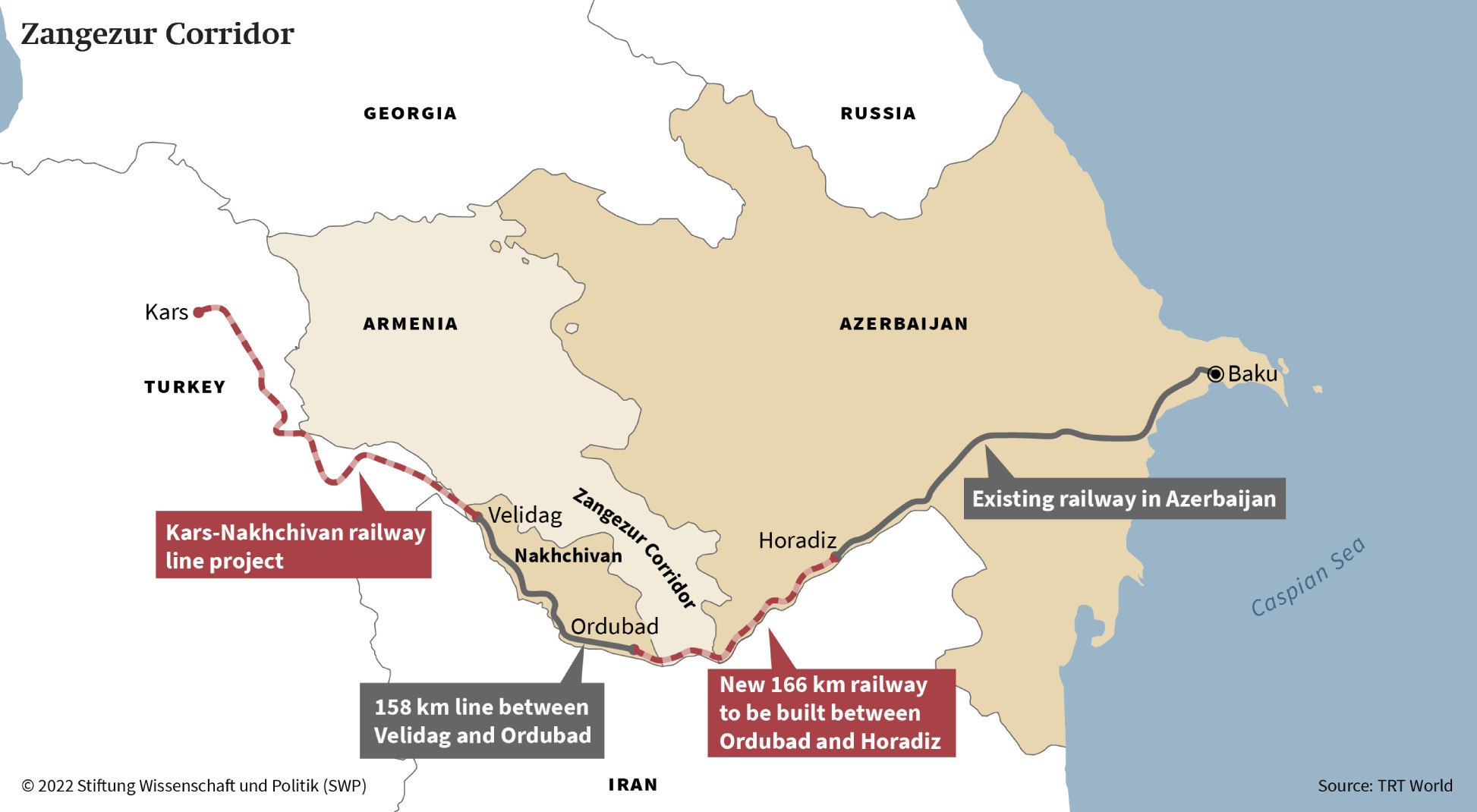
Map 1: The Middle Corridor - The Zangezur connection; a difficult terrain in an even more difficult geopolitical environment
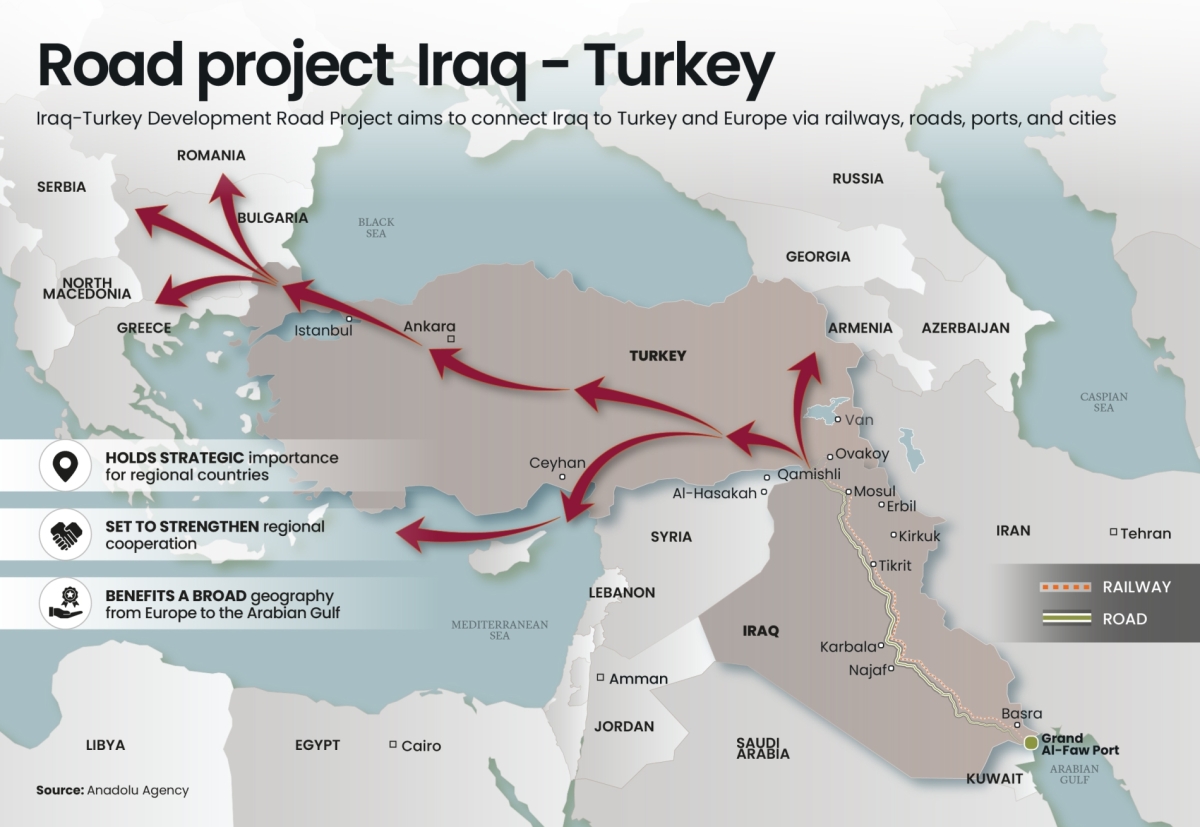
Map 2: The Southern stretch of the Middle Corridor - An ambitious Iraqi project aspiring to unite tribes and religious factions across the country
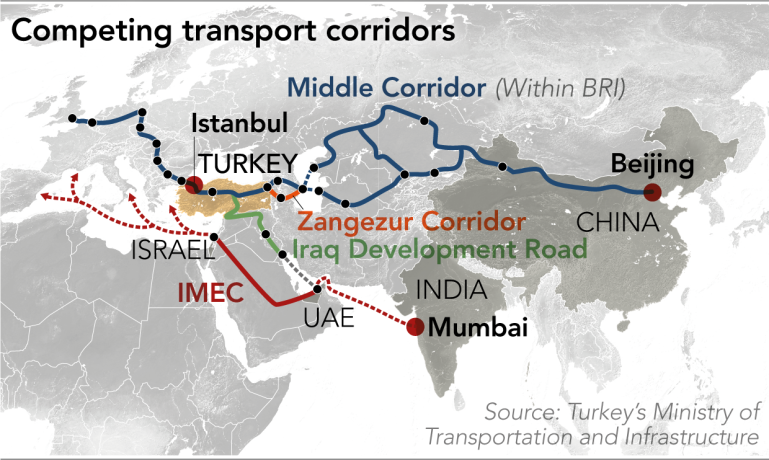
Map 3: Overview of the three competing transport corridors